Community Loans Explained: How CDFI Financing Can Support Local Growth and Long-Term Impact
Community Development Financing: A Project-Specific Approach
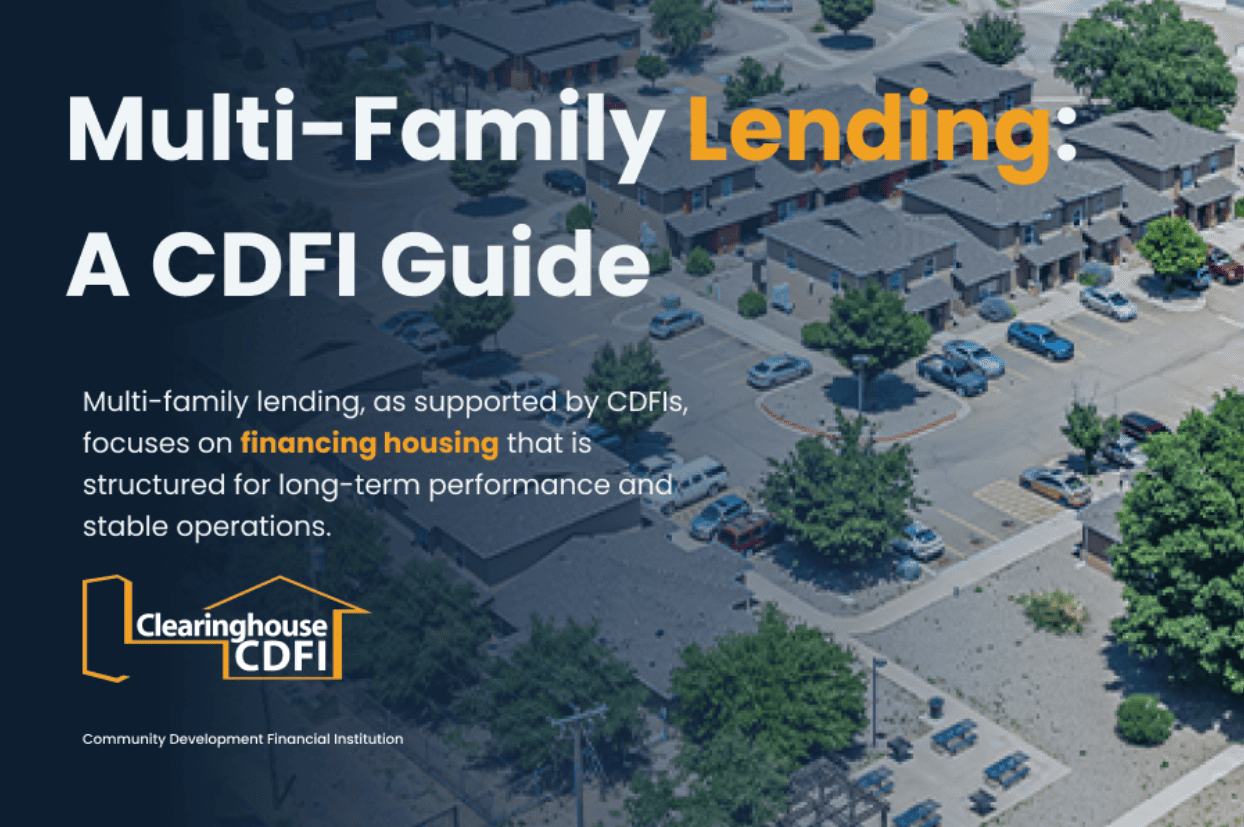
Community development projects can have financing needs that do not fit one set template. Multi-family affordable housing and community facilities, for example, may rely on very different revenue models. Small businesses and other community-focused projects can bring their own considerations, such as ownership or sources of capital, that shape the financing request.
Community development financial institutions (CDFIs) are mission-driven financial institutions certified by the U.S. Department of the Treasury’s CDFI Fund to support community development. CDFIs take several different forms with different approaches. At Clearinghouse CDFI, that mission is carried out through commercial real estate-secured lending. We evaluate financing requests individually. That means taking the time to understand the borrower and the project, including what the borrower is trying to accomplish, so we can structure disciplined financing around those specific needs.
If you’re considering CDFI financing for a community development project, it helps to know what a lender will want to understand about your project. This article examines those considerations and explains how Clearinghouse CDFI approaches projects intended to create long-term economic and community impact.
Different Projects Require Individual Approaches
Community development projects vary widely. A multi-family affordable housing development may have income shaped by affordability requirements or subsidies, while a community facility may depend on the operating performance of the organization that occupies it. Other projects may bring together several sources of financing. The property itself can introduce additional considerations, as can property ownership and operation.
Those differences do not change the need for sound financial fundamentals. They do mean that a lender needs to understand the borrower and the project, along with how its pieces work together. Clearinghouse CDFI reviews each request on its own merits rather than applying one set template to every project.
What Lenders Consider When Evaluating a Financing Request
Every financing request is evaluated individually, and underwriting considers multiple factors. Depending on the project, these factors commonly include:
- Cash flow and debt service: Does the project generate sufficient income to support the proposed debt?
- Loan-to-value (LTV): What percentage of the property’s value would the requested loan represent?
- Collateral and valuation: What commercial real estate will secure the loan? What factors affect its value?
- Want to learn more about collateral? Watch Clearinghouse CDFI’s short video on how collateral factors into commercial real estate-based financing.
- Borrower and project experience: Does the borrower or project team have relevant experience to execute the project and operate it successfully?
- Project and capital structure: What other financing is part of the project? This can include subsidies, investments, grants, or other commitments.
- Repayment: What is the expected source of repayment over the life of the loan?
This list is not exhaustive, and no single item tells the whole story. The relevance of each factor can vary by project. Clearinghouse CDFI considers the financial fundamentals in the context of the borrower and the project when structuring a community development loan.
Multiple Sources of Financing
Community development projects may rely on multiple sources of financing, sometimes referred to collectively as a project’s capital stack. A project might pair a loan with tax credit equity or a grant. Others may include public funding or borrower equity. The mix depends on the project.
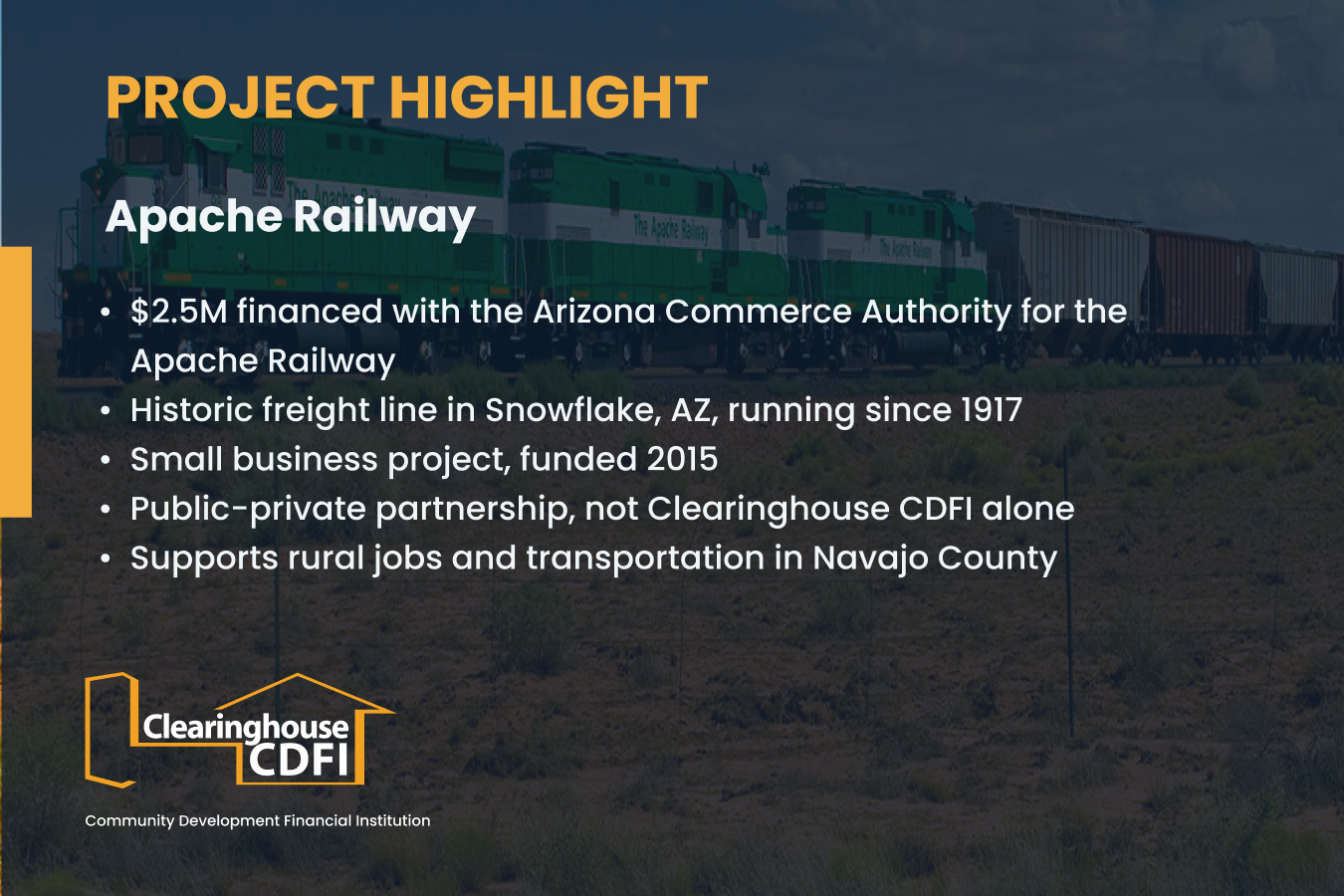
Apache Railway received $2.5 million in financing through a public-private partnership supporting rural jobs and transportation in Arizona.
A $7.5 million financing package brought together $2.5 million from Clearinghouse CDFI, in partnership with the Arizona Commerce Authority, and $5 million from other investors. The financing helped preserve a critical piece of rural infrastructure and support the railway’s continued operation and growth.
Borrowers should understand how those pieces fit together. A lender may need to know which sources are committed and when the funds will be available. Requirements tied to another source of financing can also affect the project or closing.
Projects Clearinghouse CDFI Finances
Clearinghouse CDFI provides commercial real estate-based financing for a range of projects designed to create economic and community impact. Examples include:
- Multi-Family Affordable Housing
- Charter Schools & Educational Facilities
- Special Needs Housing
- Healthcare Facilities
- Churches & Faith-Based Facilities
- Nonprofit Facilities & Community Spaces
- Small Businesses
- Office & Retail
- Mobile Home Parks
- Industrial & Mixed-Use Projects
Financing may support acquisition, refinancing, or construction. It can also be used for renovation and rehabilitation, gap financing, or operations expansion. These examples are not comprehensive. Eligibility depends on the individual project and proposed loan use, as well as the requested amount and other factors.
Projects in Action
Clearinghouse CDFI provides community development financing for projects in rural communities across the country. The examples below show some of that work in practice.
What Borrowers Can Expect
Clearinghouse CDFI begins each community development loan request with a pre-application designed to help determine whether a project aligns with basic lending criteria. Borrowers should be prepared to describe the organization and the project. They will also need to provide high-level information about the financing request, the real estate involved, and expected sources of repayment.
If a request appears to be a potential fit, a lending advisor can discuss the project in more detail. As the review continues, borrowers may be asked for financial statements or budgets. Property and project documentation may also be needed, along with other materials relevant to the financing request. When multiple sources of financing are involved, borrowers should be ready to explain how those pieces fit together. Timing or approval requirements tied to those sources may affect the transaction.
Starting the conversation early can help borrowers understand whether a request may be a fit and what information will be needed. It also gives them a clearer picture of what comes next. Current lending criteria and the full pre-application process are available on Clearinghouse CDFI’s borrower webpage.
Where Clearinghouse CDFI Fits
Clearinghouse CDFI combines disciplined commercial real estate-secured lending with a thoughtful, project-specific approach. Our mission is to provide responsible financing backed by deep lending expertise to expand economic opportunity and improve quality of life for individuals and communities with limited access to traditional capital. We evaluate each financing request on its own merits. This approach allows us to structure financing around the specific circumstances of each borrower and project.
For borrowers and brokers, that means the conversation begins with understanding the project and its financial fundamentals. A project-specific approach should not be confused with easier financing or less rigorous underwriting.
Next Step
If you are considering community development financing for a project and have commercial real estate that can serve as collateral for the loan, review Clearinghouse CDFI’s current borrower information and pre-application process. You’ll find current lending criteria there, along with details about what happens next.
Start a Financing InquiryFAQs About CDFI Financing
How long does a Clearinghouse CDFI loan take to close?
Timing varies by transaction. Project complexity and required documentation can affect the timeline. So can third-party work or approvals, and the pace at which everyone involved is able to respond. Because each financing request is different, Clearinghouse CDFI does not rely on a single closing timeline for every project. Throughout the process, our lending team communicates with borrowers about the status of the request and what is needed to keep it moving.
Do I have to be a nonprofit to apply?
No. Clearinghouse CDFI finances eligible projects sponsored by nonprofits and for-profit businesses. We also work regularly with many brokers, developers, and other types of organizations. Eligibility depends on the details of the project and financing request.
Does Clearinghouse CDFI provide mortgages for individual homebuyers?
No. Clearinghouse CDFI is a commercial real estate-based lender and does not provide individual residential mortgages. Residential properties may be considered in certain eligible commercial or community-serving contexts, depending on the project. Clearinghouse CDFI does provide financing for qualifying multi-family properties, such as affordable apartments.
What should I have ready before contacting a lender?
Be prepared to provide basic information about your project and financing request. That includes the requested loan amount and proposed use of funds, along with the real estate involved. Clearinghouse CDFI’s initial inquiry form walks prospective borrowers through the information needed for an initial review, so you can see what to prepare before submitting your request.
How are interest rates determined?
Interest rates and other loan terms depend on the individual financing request and transaction. A lending advisor can discuss current terms and the factors relevant to a specific project as part of the review process.